
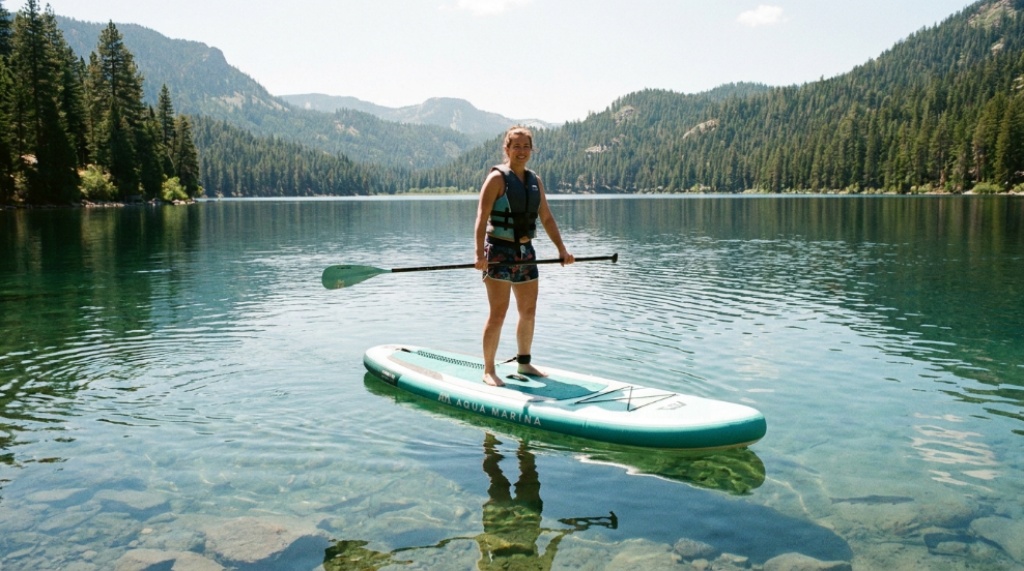
You’ve seen the photos: calm water, golden hour, and someone gliding across the surface on a stand-up paddle board. It looks effortless. But if you’re new to the sport, the real question isn’t just about looks—it’s about practicality. Is a beginner inflatable paddle board easy to use, or are you setting yourself up for a frustrating learning curve? The short answer is yes, modern inflatables are exceptionally user-friendly, but ease depends on choosing the right board, understanding your environment, and learning a few basic techniques. This guide explains everything you need to know about getting started, avoiding early mistakes, and making the most of your first sessions.
Key Takeaways
- Inflatable SUPs are easier for beginners than hard boards because they are softer, wider, and more stable in the water.
- Setup and inflation take about 10 to 15 minutes, and modern pumps make the process less strenuous than many expect.
- Board width and volume are the most critical features for stability; selecting a board with the right dimensions for your weight makes learning significantly easier.
- Learning in flat, shallow water is the single most effective way to speed up the process and build confidence.
- Portability is a major advantage, but it requires establishing a consistent routine for packing up correctly to prevent pressure damage over time.
Why Inflatable Boards Are Naturally Beginner-Friendly
Historically, paddle boards were rigid, heavy, and difficult to transport. That all changed with the introduction of drop-stitch construction, which allows a fabric shell to be inflated to high pressures, creating a surface that is both sturdy and forgiving.
For a newcomer, the inflatable design solves several problems at once. Because the board is soft, falling onto it during a clumsy mount is more like bumping a firm mattress than hitting a fiberglass slab. This physical safety net makes a significant psychological difference. When you are not worried about hurting yourself, your body relaxes, and your balance improves naturally.
Furthermore, inflatable boards are generally thicker than rigid boards. Most beginner models range from 6 to 10 inches in thickness. This extra volume provides substantial buoyancy, allowing heavier riders, or those with less core strength, to stay above the waterline without feeling like the board is tippy or unstable.
Stability Comes from Width, Not Just Length
One of the biggest misconceptions is that a longer board is automatically more stable. In reality, stability is primarily dictated by width. Beginner boards typically measure 32 inches or more across. This wide platform acts like a pontoon, providing a massive base of support. When you place your feet parallel and roughly shoulder-width apart, the board does not react to every small muscle twitch in your ankles.
When you are searching for your first board, you should look for specific specifications rather than just relying on brand reputation. A board that is around 10 to 11 feet long and 32 to 34 inches wide, with a thickness of at least 6 inches, is the ideal “Goldilocks” zone for most adult beginners. This sizing allows for comfortable cruising while retaining the stability you need to stand up without holding your breath.
What Actually Happens During Your First Session?
Let’s walk through a realistic first experience so you know what to expect. You can’t just throw an inflatable in the water and go. There is a specific sequence of events, and understanding it is the key to deciding whether this sport is truly “easy” for you.
Inflation: The First Hurdle
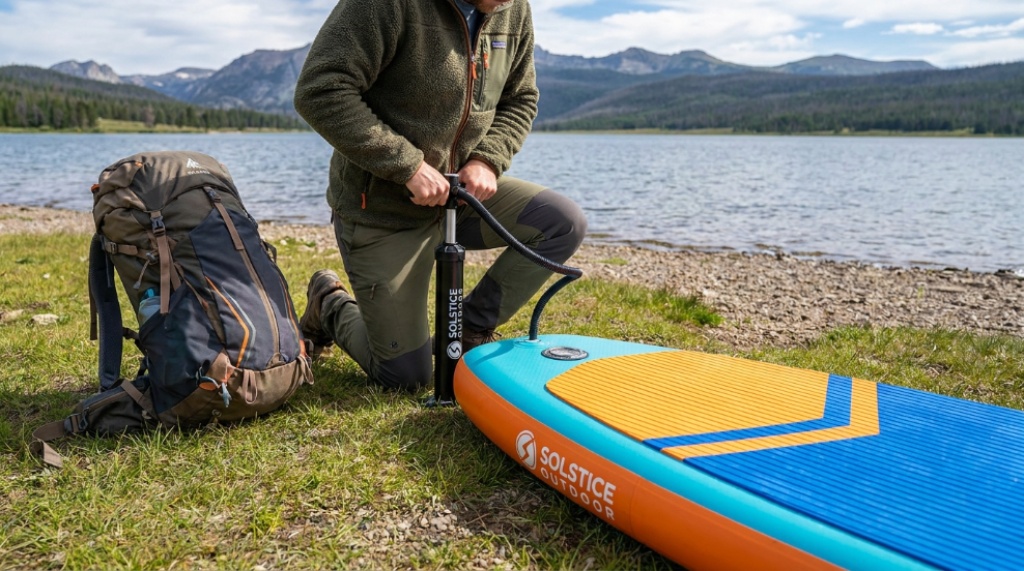
The most common complaint about inflatable boards is the setup. You will need to attach a pump hose to the board’s valve and inflate it to roughly 15 PSI (pounds per square inch). If you are using a manual pump, this can take anywhere from 700 to 1,500 strokes depending on the pump’s cylinder size.
However, the process is not as brutal as it sounds. Most quality boards come with a dual-action pump that pushes air on both the upstroke and the downstroke. This cuts the inflation time roughly in half compared to single-action pumps. For those who have physical limitations or simply want to save time, an electric air pump is a worthy investment. It can take a board from flat to rigid in about six to eight minutes while you carry on with other tasks.
Getting On the Board: The Right Technique
Once inflated, the board will feel solid and rigid. Here is where many beginners make their first mistake: they try to climb on in deep water. This requires significant core strength and often leads to tipping.
The easiest method is to use shallow water. Stand next to the board with the water roughly at knee or waist height. Place your paddle across the board perpendicular to the rails (the sides). This acts as a stabilizer. Then, place both hands on the center of the deck and push your chest up into a plank position before swinging your legs around. This distributes your weight evenly and prevents the board from rocking sideways.
Core Techniques That Make Paddling Easier
Once you are on the board, standing up is only half the battle. Moving forward efficiently requires a shift in perspective. On a paddle board, you don’t “row” the water like a canoe; you pull the water past you.
Beginners often bend at the waist and try to muscle the blade through the water. This quickly exhausts the shoulders and lower back. Instead, focus on a technique known as the “core twist.” Engage your abdominal muscles and rotate your torso as you plant the paddle. This allows your larger core muscles to do the work rather than your smaller arm muscles.
Also, remember to switch sides frequently. Paddling on one side for ten minutes will slowly but surely turn the board in a circle. A common mistake is taking long, sweeping strokes far away from the board, which causes the nose to veer sharply. Instead, take shorter, more frequent strokes closer to the rail of the board to maintain a straight line.
Navigating Your Environment for Success
The water conditions you choose drastically affect the ease of your session. A mirror-flat lake or a protected harbor is perfect for a first outing. These areas have no waves, so your board remains still, allowing you to focus entirely on your balance and paddle stroke. Conversely, choppy ocean water or busy rivers with boat wakes will constantly move the board beneath your feet, requiring advanced balance to correct.
If you want to practice in the surf zone, be prepared for a challenge. Even experienced flat-water paddlers find ocean surfing difficult because the board can lift up and slide sideways on a breaking wave. For the true beginner, this environment is dangerous and extremely frustrating. Save the ocean for later; start on the flat water to build your muscle memory and confidence.
Comparing Inflatable vs. Rigid Boards for Newcomers
To understand how “easy” an inflatable is, it helps to compare it directly with a hard board. Both get you on the water, but they offer different experiences regarding logistics and performance.
| Feature | Inflatable Board | Rigid (Hard) Board |
|---|---|---|
| Storage | Folds down to the size of a large suitcase; can be stored in a closet. | Must be stored on racks; takes up permanent space in a garage or room. |
| Transportation | Fits inside the trunk of almost any car. | Requires roof racks, truck beds, or specialized straps. |
| Durability | Bounces off rocks and docks without damage; soft if it hits your head. | Prone to dings and cracks from impacts; can be sharp on contact. |
| Performance | Slightly slower in the water and may flex under very heavy loads. | Faster, tracks straighter, and offers superior glide when paddling long distances. |
| Setup Time | Requires 10–15 minutes of inflation before launching. | Zero setup time; simply carry it to the water. |
| Weight | Boards are heavier than hard boards (often 20 lbs+), but easier to carry due to soft handles. | Lighter to carry short distances, but bulky and awkward to maneuver through doorways. |
As the table illustrates, the inflatable offers superior convenience for storage and transport, making it “easier” to actually get out on the water at a moment’s notice. The rigid board offers a “cleaner” ride but requires significant infrastructural support at home to be practical.
Selecting the Right Beginner-Specific Features
Not all inflatable boards are created equal. When you are reading specifications for a beginner inflatable paddle board, you need to look past the marketing photos and check the hardware. There are three components on the board that will directly impact how easy it is to use: the fin, the deck pad, and the handles.
The Fin Setup: To Have or Have Not
Most entry-level boards use a center track fin or a slide-in clip fin. These are excellent for beginners because they require no tools. If you are in shallow water and the fin scrapes the bottom, it will pop out or slide up rather than breaking. This allows you to retrieve it, clip it back in, and continue your day.
If the board specs mention a “thruster” setup (three fixed fins), realize that while these offer great directional stability, they can also catch on seaweed and debris. For a beginner, a single, tool-free fin is the easiest and most forgiving option.
Deck Pad and Handles
Look for a board with a full-length, diamond-grooved traction pad. This feels like soft sandpaper under your feet and prevents slipping when your feet are wet. A cheap, glossy pad will make you feel like you are standing on ice.
Also, check the carry handles. There should be one central handle on the deck that you use during the paddle stroke. But top-tier boards also include a nose handle. This nose handle is invaluable when you are carrying the board to the water or pulling yourself out of the current, as it allows you to keep your arm fully extended, Before making your purchase, make sure you avoid common pitfalls by reading our guide on the Biggest Inflatable Paddle Grade Board Buying Mistakes.
Common Beginner Mistakes That Ruin the Experience
Many people say paddle boarding is “hard” simply because they never learned the correct positioning. Here is how to avoid the pitfalls that cause unnecessary falls.
- Looking down: Your head weighs around 11 pounds. As you transfer your weight onto the board, where your head goes, your body follows. If you stare at your feet to make sure they are positioned correctly, you are throwing your center of gravity forward and causing the board to pitch. Keep your eyes fixed on the horizon. This instantly stabilizes your balance.
- Hunching your shoulders: Tension is the enemy. If you hunch your shoulders up to your ears, your balance becomes rigid and unresponsive. Let your shoulders relax. Allow your knees to act as shock absorbers, bending slightly to absorb the water movement, much like skiing down a bumpy slope.
- Death-gripping the paddle: Gripping the paddle too tightly causes fatigue in the forearms, leading to cramping. Hold the paddle with a relaxed, “fist-grip” with your fingers. The paddle should feel like an extension of your arm.
- Paddling in windy conditions: Inflatable boards are generally heavier and higher out of the water, catching the wind like a sail. If you go out in 15+ mph winds, you will struggle to paddle back. Always check the weather forecast and paddle into the wind initially so that the wind helps you return to your launch point.
Maintenance: Keeping It Easy Over Time
The “ease” of using an inflatable is negated if you have to replace it after a year due to mold or pressure loss. Fortunately, maintenance is straightforward if you are disciplined.
The most critical rule is to dry the board before storage. Inflatable boards are made of military-grade PVC that does not absorb water, but standing water can bleed into the seams over long periods. Wipe the board down with a towel immediately after use.
When you store the board, roll it from the nose down, but do not fold it sharply. Sharp folds create permanent creases in the material that weaken the glue and lead to air leaks. Store it loosely rolled, perhaps with the fin removed, in a cool place away from direct sunlight.
Finally, do not over-inflate. While 15 PSI is standard, high temperatures cause the internal air pressure to expand. If you inflate to the max PSI on a cool morning and leave the board in the sun or on a hot car, the pressure can spike to 18 PSI, causing delamination of the seams. Always deflate the board slightly if you are storing it in a hot environment.
Frequently Asked Questions
Can I take an inflatable paddle board into the ocean?
Yes, you can. The high-pressure inflatable construction is rugged enough to handle surf and saltwater. However, you must rinse the board thoroughly with fresh water immediately after use to prevent salt crystals from corroding the valves and metal fin screws. For your first few sessions, choose a bay or calm ocean inlet rather than rough surf.
How long does it take to stand up on an inflatable paddle board?
For most people in calm water, the initial act of standing up can be achieved on the very first try if they use the correct technique (keeping the head up and core engaged). Paddling will feel more natural after 15 to 30 minutes of continuous practice. The learning curve is heavily influenced by the width of the board; avoid boards narrower than 32 inches if you are a beginner.
Is it harder balance on an inflatable than a hard board?
No. Because inflatable boards are often intentionally manufactured wider to provide stability for beginners, they are generally easier to balance on than narrower, race-style hard boards. The air-filled body gives you slight flex underfoot, acting like a shock absorber, whereas a hard board is rigid and reacts to every water ripple.
How much air pressure do I need in my paddle board?
Standard inflatable boards require 12 to 15 PSI. Do not rely on “feeling” the board; always use the pressure gauge on your pump. Riding below the recommended PSI makes the board feel “spongy” and floppy, which significantly decreases stability. Riding at the recommended PSI makes the board feel as rigid as a hard board.
Do I need to buy a special wetsuit to paddle board?
That depends entirely on water temperature, not air temperature. If you fall in, cold water can cause a dangerous cold-water shock response. In summer, board shorts or a swimsuit are fine. In spring or fall, a wetsuit rated for the water temperature is highly recommended. Hypothermia leads to loss of coordination, which makes what is normally an easy activity dangerous.
Conclusion
Inflatable paddle boards are highly accessible for beginners, primarily due to their forgiving construction and stable sizing. The ease of paddling comes from the correct setup, proper weight distribution, and choosing the right water conditions. While inflation takes effort, the reward is a portable, durable craft that removes storage headaches. Begin on wide, calm water, keep your head up, and let the board’s buoyancy work for you. Rather than wrestling with the learning curve, you can let it turn into a peaceful routine of exploration on the water.