
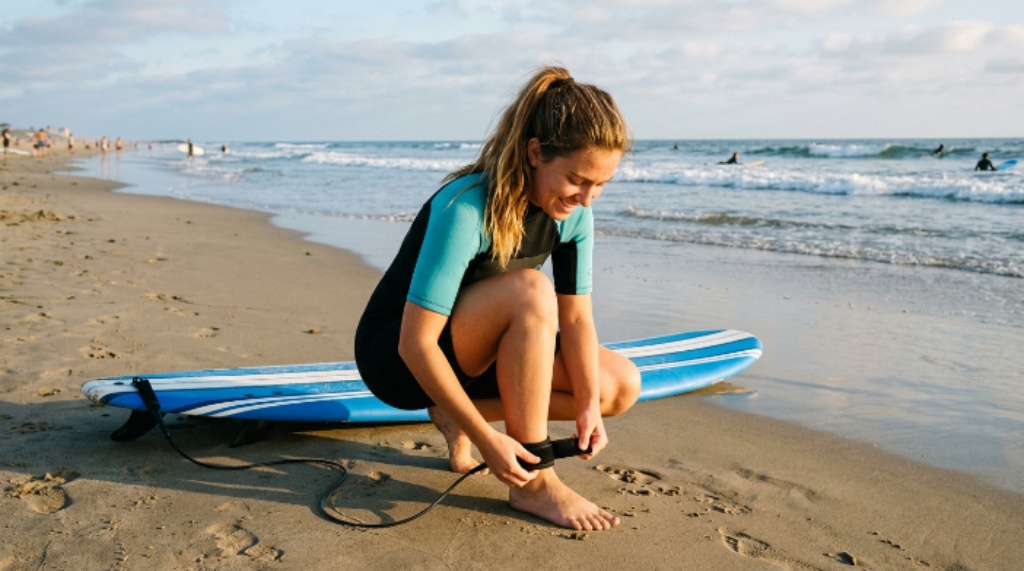
If you are new to surfing, buying gear can feel overwhelming. There is a lot to choose from. However, one item you should never skip is a surfboard leash. It is a simple tool, but it could save your life. This guide will walk you through everything you need to know before making your first purchase.
What Is a Surfboard Leash and Why Do You Need One?
A surfboard leash is a cord that attaches your ankle (or knee) to your board. When you wipe out, the leash stops your board from drifting away. Without one, your board could travel far and fast — posing a danger to you, to other surfers, and to swimmers nearby.
Every beginner surf gear list should start here. A leash is non-negotiable. It keeps your board close so you always have something to hold onto in the water. Additionally, it saves you the exhausting swim back to shore every time you fall off.
Think of it as your first safety net in the ocean.
Understanding Leash Lengths
Leash length matters more than most beginners realize. The general rule is simple: your leash should be roughly the same length as your surfboard.
Here is a quick breakdown:
- 6-foot leash — best for shortboards in the 5’8″ to 6’4″ range
- 7-foot leash — ideal for mid-length boards around 7 feet
- 8 to 9-foot leash — suited for longboards and funboards
- 10-foot leash — designed for longboards over 9 feet
Why does this matter? A leash that is too short will cause your board to snap back too quickly after a wipeout. That creates a real risk of injury. On the other hand, a leash that is too long becomes tangled and hard to manage. Therefore, matching the leash to your board length is the smart starting point.
Leash Thickness: Thin vs. Thick
Leash thickness affects both drag and durability. Thicker leashes are stronger and better for larger waves. Thinner leashes create less drag in the water, which suits smaller surf conditions.
Here is a simple guide:
- 5mm to 6mm — light conditions, small waves, longboard cruising
- 7mm — everyday surfing, moderate surf
- 8mm and above — bigger waves, powerful conditions
As a beginner, you will likely be surfing in small to medium conditions. Therefore, a 6mm to 7mm leash is a reliable choice. It is thick enough to hold up, but not so heavy that it slows you down.
The Calf Leash vs. Ankle Leash
Most surfers use an ankle leash. It straps around the ankle and works well for shortboards, mid-lengths, and most beginner setups. It is comfortable, easy to use, and widely available.
However, if you are riding a longboard, you might prefer a calf or knee leash. This type sits higher on the leg. It keeps the leash out of the way when you walk up and down the board — a technique called nose-riding. For longboard beginners, this is worth considering.
For most newcomers, though, an ankle leash is the right place to start.
Key Features to Look For
Not all leashes are built the same. When you are shopping, pay attention to these features:
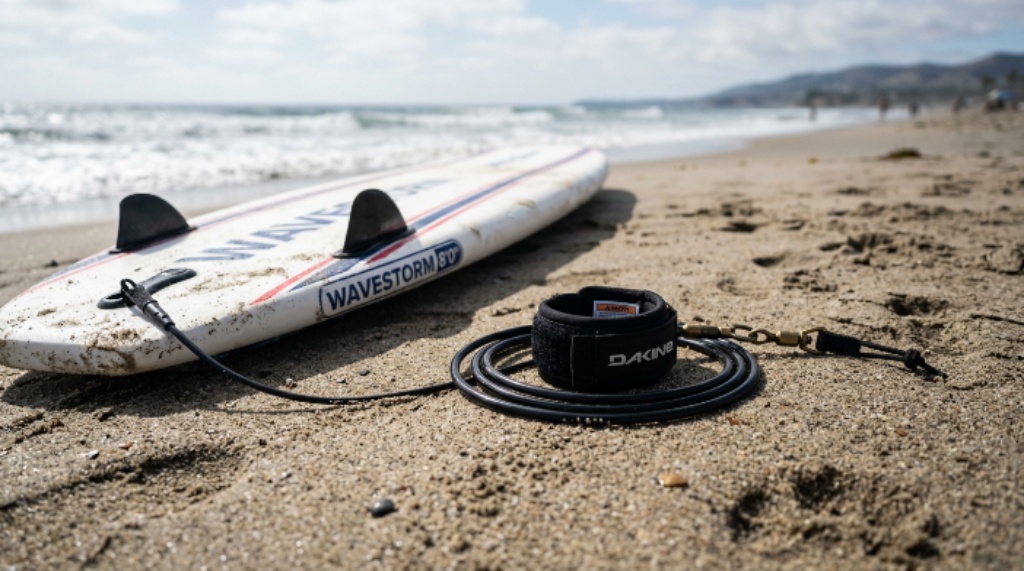
- Swivel joints — these prevent the leash cord from tangling. Look for double swivels at both the rail saver and the cuff for the best result.
- Rail saver — this is the wide strap that connects the leash to your board. A wider rail saver protects the tail of your board from the cord cutting into it over time.
- Velcro cuff — this wraps around your ankle. It should be snug but not tight. Look for padded versions for extra comfort.
- Quick-release tab — some cuffs include a quick-release system. In rare emergencies, you can pull the tab to free yourself from the leash instantly. This is a useful safety feature.
A good beginner surf gear investment means looking for these details, not just the lowest price tag.
Where Conditions Come In
The ocean changes daily. The leash you choose should match the surf you plan to ride.
For calm, small waves, a standard comp leash (around 5mm to 6mm) works perfectly. These are lightweight and flexible. For beach breaks with moderate power, a regular 7mm leash handles the job well.
If you ever find yourself in stronger surf — even as you improve — switch to a thicker, heavy-duty leash. Stronger waves put more stress on every piece of your surf gear checklist, including the leash. A snapped leash in powerful surf is dangerous and disorienting.
Additionally, always check the conditions before you paddle out. Match your gear to the day.
How to Attach Your Leash Correctly
Buying the right leash is only part of the process. You also need to attach it properly.
Follow these steps:
- Locate the leash plug at the tail of your surfboard. It is a small plastic cup embedded in the board.
- Thread the leash string (the thin cord that comes with your leash) through the leash plug and tie it in a double knot.
- Loop the rail saver through the leash string and connect it securely.
- Wrap the cuff around your back ankle and fasten the Velcro firmly.
Always double-check the connection before paddling out. A loose attachment can come undone in the water. Take an extra 30 seconds to check — it is always worth it.
What to Expect to Spend
Surfboard leashes are one of the more affordable items on any surf gear checklist. You can find a solid beginner leash for around $20 to $40. Premium options with better materials, stronger swivels, and added features run from $40 to $70.
Avoid the cheapest options. Very inexpensive leashes tend to break faster and offer less protection. However, you do not need to spend top dollar either. A mid-range leash from a trusted brand will serve you well through your first season and beyond.
Some popular and reliable leash brands include Dakine, FCS, Ocean & Earth, and Creatures of Leisure. All of these brands produce quality beginner options.
Caring for Your Leash
A leash lasts longer when you take care of it. After each surf session, rinse it with fresh water. Salt and sand accelerate wear on the cord and the Velcro. Let it dry in the shade rather than direct sunlight, as UV rays degrade the material over time.
Inspect your leash regularly. Look for fraying along the cord, weakened swivel joints, or Velcro that no longer grips well. Replace your leash if you notice any of these signs. A worn-out leash is not worth the risk.
Conclusion
A surfboard leash is one of the most important pieces of equipment you will ever buy as a surfer. It keeps you connected to your board, protects those around you, and gives you confidence in the water. When choosing one, focus on matching the length to your board, picking the right thickness for your conditions, and looking for solid construction details like swivels and a good rail saver.
Additionally, always attach it correctly and inspect it before each session. A small investment in the right leash pays off in safety and peace of mind. As you build your beginner surf gear setup, make the leash your very first purchase. Everything else can come after — but this one should never wait.
Frequently Asked Questions
Can I surf without a leash?
Technically yes, but it is strongly discouraged for beginners. Without a leash, a lost board becomes a hazard for you and others in the water. Many surf breaks and surf schools actually require one.
How often should I replace my surfboard leash?
Most surfers replace their leash once a year, or sooner if they notice fraying, weakened swivels, or a cuff that no longer holds tight. Do not wait until it breaks in the water.
Does the leash go on my front ankle or back ankle?
Always attach the leash to your back ankle — the foot closest to the tail of your board. This gives you the most control and keeps the cord out of the way when you ride.
What leash should a complete beginner buy?
A 7-foot, 7mm ankle leash is a great all-around starting point for most beginners riding a funboard or mid-length board. It handles a wide range of conditions and is easy to manage.
Is a more expensive leash always better?
Not necessarily. A mid-range leash from a reputable brand will outperform a cheap one and serve you just as well as a premium version in most beginner conditions. Focus on quality construction, not just price.
Related Topics:
Child-friendly bike rests on Manhattan routes