

You’ve finally decided to trade in that lumpy, heat-trapping synthetic pillow for a buckwheat hull option. Smart move. But here’s the problem: California is a big state with a lot of retailers, and buckwheat pillows aren’t one-size-fits-all. The fill weight, the type of hull, the cover fabric, and even the way the pillow is sewn can completely change your experience. If you’re looking for a comfortable buckwheat pillow in California, you need to know what separates a neck-saving investment from a dusty, rock-hard mistake. This guide walks you through exactly what to look for, how to size it, and where to focus your search in the Golden State.
Key Takeaways
- California’s climate makes the breathability of buckwheat hulls a major advantage, but you must pay attention to the cover fabric to avoid excessive noise and moisture issues.
- Fill weight is the single most important factor in comfort; a pillow that is too full will feel like a brick, while one that is under-filled provides zero support.
- Local pick-up, niche wellness stores, and specialized online retailers serve Californians better than big-box generic options because they offer different hull sizes and custom fill levels.
- Budget isn’t just about the sticker price; the lifespan of buckwheat hulls (often 5–10 years) makes a higher upfront cost more economical than replacing foam pillows every 18 months.
- Understanding the difference between a “neck pillow” and a “full sleeper pillow” will save you from buying the wrong shape for your primary sleep position.
Why Buckwheat Pillows Actually Work
Buckwheat pillows are filled with the outer husk of the buckwheat grain. Unlike memory foam, which molds to your shape by yielding to heat and pressure, buckwheat hulls move out of the way. They shift and settle to support the natural curve of your cervical spine, providing a firm, stable base that doesn’t collapse overnight.
The primary benefit is spinal alignment. When you lie on your side, the pillow needs to fill the gap between your head and the mattress. Buckwheat hulls do this exceptionally well because they provide a high loft (thickness) with very little “give.” They push back against your head until the neck is in a neutral, straight line with the rest of your spine. For back sleepers, the hulls can be pushed to the edges, creating a “cradle” effect for the head while supporting the neck.
Another significant advantage is temperature regulation. The hulls are hollow, allowing air to circulate freely through the pillow core. This prevents the heat buildup that is common with polyester or memory foam. In California’s varied climate—from the humid coast to the dry inland valleys—this breathability is a game-changer for hot sleepers.
The “Heavy” Factor
A standard buckwheat pillow weighs between 5 and 8 pounds. This weight is what keeps it in place. It does not slide around during the night, which is excellent for people who toss and turn or share a bed. However, this weight also means you cannot fluff it like a normal pillow. You have to shape it with your hands before you lie down. Adjusting to this tactile difference is often the steepest learning curve for new users, not the firmness itself.
Matching the Pillow to Your Sleep Position
The most common mistake Californians make is buying a “one-size-fits-all” buckwheat pillow. There are distinct shapes and depths designed for specific sleeping positions. Buying the wrong type will result in neck stiffness and frustration.
For side sleepers, you need a thick, high-loft pillow. Your shoulder width dictates the required loft. A broader shoulder requires a deeper pillow to keep the head from tilting upward toward the ceiling. Look for a rectangular pillow with a fill weight of around 4 to 5 pounds of hulls.
For back sleepers, you need a flatter profile. A high pillow under the back forces the chin toward the chest, flattening the natural curve of the neck and causing headaches. Look for a pillow with a lower fill weight (around 2.5 to 3 pounds), or use the “contoured” buckwheat pillows that have a dip in the middle for the head and a raised rim for the neck.
Adjustability Matters
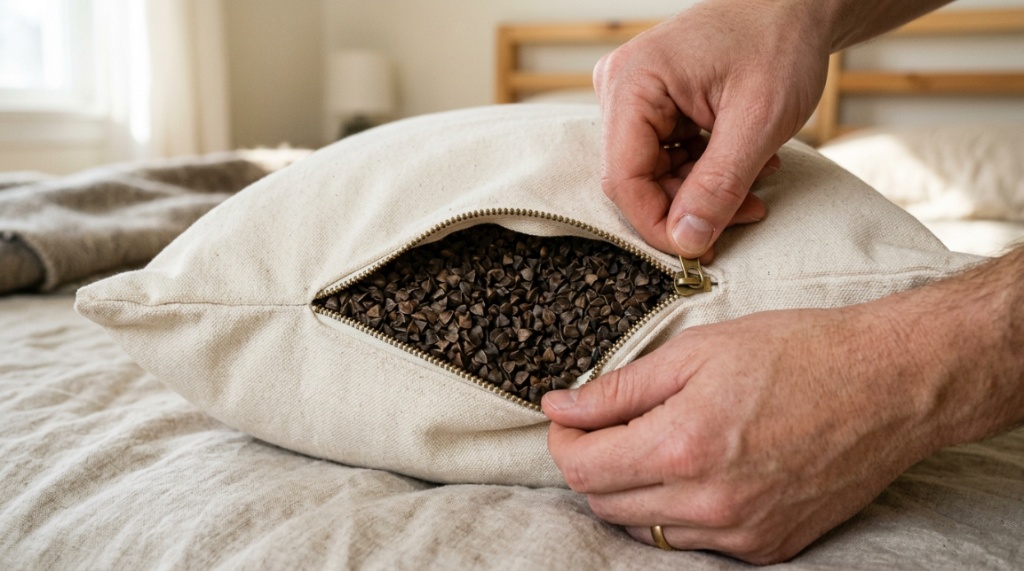
Regardless of your preferred position, you should seek out a pillow that has a zipper. This is non-negotiable. No matter how many pounds of hulls the manufacturer includes, the exact amount you need is unique to your body mechanics and mattress firmness.
- Remove hulls: If the pillow feels too tall or too hard, unzip and scoop out a handful of hulls. Store them in a bag in case you need to add them back.
- Add hulls: If the pillow feels like a flat pancake, you need more fill. Some retailers sell additional hulls by the pound.
- Sealing: Always double-check that the zipper has a fabric flap covering it. Otherwise, you will feel the cold metal against your neck, and the zipper teeth can catch on the pillowcase.
Cover Fabric: The Difference Between “Okay” and “Comfortable”
Most first-time buckwheat users complain about the “crunching” sound. The hulls rub against each other and against the fabric. While you will get used to the sound, the cover fabric dictates how loud that crunch is and how soft the pillow feels against your face.
Do not buy a buckwheat pillow with a thin, 200-thread-count cotton cover. It will feel rough, and the hulls will feel like a bag of pebbles. Instead, look for a cover with a high thread count or a blend that adds softness.
Selecting the Right Shell
- Organic Cotton (300-600 thread count): This is the standard. It is breathable and gets softer with washing. It provides a nice barrier between you and the hulls, muffling the crunch slightly.
- Cotton/Modal or Bamboo Blends: These are smoother and silkier. If you sleep hot, these fabrics are better at wicking away moisture than pure cotton.
- Linen: Durable and highly breathable, but heavily textured. Not ideal for sensitive skin.
While the cover is washable, the hulls themselves are not. You must never wash or soak buckwheat hulls. They will rot, mold, and clump together. To clean the hulls, you must remove them from the cover, spread them on a baking sheet, and bake them at a low temperature (or leave them in the sun) to remove moisture.
Navigating Retail Options in California
California has a unique retail landscape for buckwheat products due to the large health-conscious demographic and the prevalence of organic farming in the Central Valley. You have three main avenues: Big-box stores, specialized online retailers, and local niche stores.
Big-Box Stores and Mass Retailers
Places like Target, Costco, or Bed Bath & Beyond often stock a generic buckwheat pillow. These are usually manufactured overseas with smaller hulls and lower fill weights. While they are cheaper (often under $50), they tend to lose their shape quickly and offer inconsistent support. If you buy one of these, be prepared to immediately remove a significant amount of fill to make it usable. They are great for testing the concept but rarely serve as a long-term comfortable solution.
Specialized Online Retailers
This is where you will find the best quality and the most customization. Online stores that specialize in sleep products often import premium, larger hulls from Japan or Korea (where buckwheat pillows are the traditional standard). You can select the exact fill weight, the type of cotton, and the shape (gusseted vs. flat). Furthermore, online retailers usually offer a return policy that allows you to exchange the pillow if the fill is wrong.
If you are tired of trying to guess which pillow will work, researching the specific attributes—such as hull size and zipper quality—on a specialized site is your best bet. You can find a curated list of top-rated options that cater to specific needs and preferences, ensuring you don’t end up with a neck injury from a pillow that is too thick.
Hull Size and Origin
This is the most overlooked factor in buckwheat pillow comfort. You might think all hulls are the same, but the size of the hull dramatically affects the feel.
| Hull Type | Size | Feel | Best For |
|---|---|---|---|
| Standard Hulls | Small (5-6mm) | Flows easily, feels closer to a beanbag. More “mesh-like” and moves quickly. | Back sleepers, those who like to shift the pillow shape constantly. |
| Japanese / Large Hulls | Large (8-12mm) | Chunkier, locked in place. Provides a more rigid, supportive feel. Less likely to shift under pressure. | Side sleepers, those who need a stable base and suffer from neck pain. |
The origin matters too. Hulls grown in the United States are often thicker-skinned than those grown in China. Thicker skins mean more durability, but they also have a slightly louder sound. Organic hulls are preferable if you have allergies, as they have not been treated with pesticides.
Why Size Matters for CA Climate
In the humid coastal areas of California (San Francisco, San Diego), smaller hulls can absorb moisture from the air, making the pillow feel damp and heavy. Larger hulls have more air space around them in the pillow core, and they are less likely to clump in humidity. Conversely, in dry interior climates (Sacramento, Fresno), the hulls will dry out and shrink slightly; you might need to add more fill as the pillow settles over time.
How to Test Adjustability at Home
There is a learning curve for buckwheat pillows. Do not expect to have a perfect night’s sleep on day one. Your neck has likely been misaligned for years by soft pillows. When you switch to buckwheat, you are forcing the muscles to relax into a new position.
Here is a step-by-step process to adjust your pillow for immediate comfort:
- Start flatter than you think. On the first night, remove about 20% of the hulls immediately. It is easier to add more than to deal with a stiff neck the next day.
- Shape the pillow. Before lying down, push the hulls away from the center. Create a shallow trough where your head will go, but keep the hulls built up under the neck curve.
- Lie still for 5 minutes. Allow your head to settle. If you feel pressure on the jaw or the base of the skull, it is too high. Remove more hulls.
- Warm-up period. Give it 3 nights. If night one feels too hard, but you sleep without a headache, keep going. Your neck is lengthening. After three nights, adjust the fill again.
Beware of “gusseted” buckwheat pillows. A gusset is a fabric insert that runs along the edge of the pillow, making the sides taller than the center. This is great for side sleepers who need that extra height at the shoulder, but poor for back sleepers. If you buy a flat (non-gusseted) pillow, you have more versatility in shaping it.
Territorial Considerations and Support
If you have a chronic neck condition (such as cervical kyphosis or a recent whiplash injury), do not switch to buckwheat without consulting a physical therapist. The firm support of buckwheat hulls can aggravate an acute injury if the head is not aligned perfectly. However, for general stiffness and morning pain caused by collapsing foam pillows, buckwheat often resolves the issue because it keeps the cervical spine in a neutral position all night.
Also, consider the mattress you are sleeping on.
– Extra-firm mattress: Your hips and shoulders don’t sink as much, so you need a slightly *lower* loft pillow.
– Soft mattress: Your shoulder sinks into the mattress, reducing the gap between head and bed, meaning you need a *lower* loft pillow.
This dynamic is why the adjustability of the zipper is so crucial. A pillow that is perfect on a firm hotel bed might be too tall on your soft mattress at home.
Frequently Asked Questions
Are buckwheat pillows noisy?
Yes, initially. The hulls produce a crunching sound when you move. Most users adapt to this within a few nights. Using a thicker cotton pillowcase over the bedding reduces the noise significantly. The sound is often described as similar to a rustling leaf, not a crackle.
How long does a buckwheat pillow last?
If properly maintained (and not exposed to moisture), buckwheat hulls can last 5 to 10 years without losing significant support. Unlike memory foam, they do not break down or flatten over time. You may need to top up the fill after a year as the hulls polish and settle, For upgrading your bedding setup across other rooms or regions, check out our guide on finding Affordable Couch Pillows in Florida to match your home style.
Can I wash a buckwheat pillow?
You can wash the cover in a machine. You must never wash the hulls themselves. To clean the hulls, pour them into a large bucket, rinse them with vinegar and water (if necessary), and dry them thoroughly in the sun or on low heat in an oven on a baking sheet. If you skip the drying, they will mold.
Is a buckwheat pillow good for a child?
Buckwheat pillows are not recommended for infants due to suffocation risk and breathing safety. For older children (8+), they can be excellent for posture, but you must remove a large portion of the fill so the pillow is very flat, almost like a mat, to support their developing neck.
Why does my buckwheat pillow feel so hard on the first night?
You are likely used to the “give” of foam or down. Buckwheat hulls do not compress much. This firmness is what provides support. If it feels like a rock, you have too much fill. Unzip the pillow and remove 1 to 2 handfuls of hulls. Sleep on it at the lower loft for a few nights before deciding if you need to add more back.
Conclusion
Finding a comfortable buckwheat pillow in California is less about “which brand” and more about “which configuration.” You must prioritize a zipper for adjustability, choose the hull size based on your sleep position, and pick a breathable, high-quality cotton cover. The heavier weight and firmness will take a few nights to adjust to, but the payoff is a consistent, neutral spinal alignment that eliminates the morning neck pain caused by collapsing foam. Focus on reputable online sources that offer organic, high-quality Japanese or domestic hulls and transparent fill weights. Skip the cheap import options at big-box stores—they will only frustrate you. Take the time to remove or add hulls to dial in the perfect loft, and you will have a sleep solution that lasts a decade.