
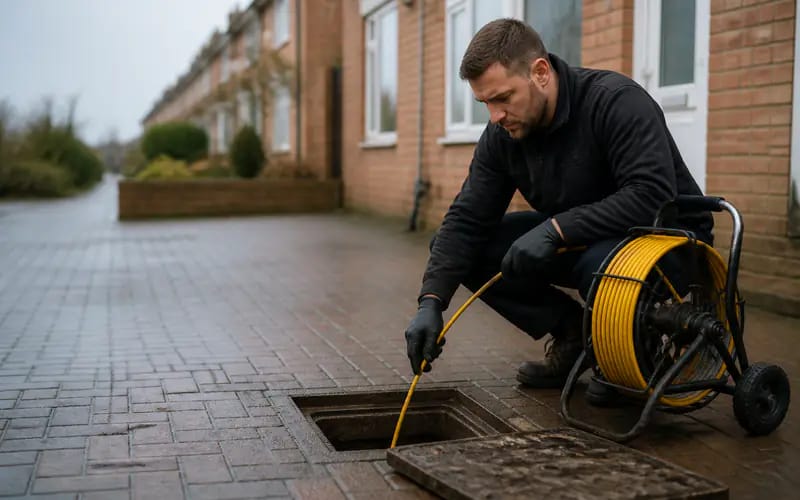
The footage from your drain survey will show you what has been seen in your drains but there is so much more to a drain survey than just the footage from the camera down the drain.
Standing Water Can Hide The Pipe Wall
Water in a pipe means the surveyor can only see the part of the pipe under the surface of the water. The pipe above the water line will not be seen by the camera and therefore any deterioration to the pipe walls, joints etc. could be missed on the surveyor’s report. It’s usually necessary for the drain to be jetted first to clear the pipe of water and then the camera can be pushed through to get good quality video and images of the inside of the pipe. The report may state that there is standing water in parts of the drain and it would be beneficial to have the drain jetted and a re-survey carried out.
A Severe Blockage Stops The Camera Dead
The length of a CCTV survey is generally dependant upon the blockage or collapse within the drainage system. A solid blockage, root invasion or a collapse deeper within the drainage system can prevent the CCTV camera from proceeding any further. Although useful information is gained from being able to survey the length of drainage prior to the blockage, further work such as rodding or excavation may be required in order to complete a full survey of the drainage system.
Footage Doesn’t Measure Structural Strength
The camera will show up any cracks or other damage to the pipe. However, the camera cannot tell you how much structural weakness remains in the surrounding pipe wall and how long it will be before it fails. The same type of crack can indicate very different problems, depending on the type of pipe, the type of soil it is buried in and other factors above the ground. Such matters are generally a matter of the surveyor’s experience and judgment.
Leaks Into The Surrounding Soil Go Unseen
While a crack in a drain can appear to be quite obvious on a CCTV survey image, the image alone cannot confirm whether or not any water is leaking through the crack and percolating away into the surrounding ground. It is only through further tests, such as an air or water pressure test where the drain is isolated and then tested for pressure loss over time, that you can be 100% sure of any leaks. A slow leak can cause considerable damage to the surrounding ground over time and can cause sinks and toilets to block on occasion. Additionally, surface water may collect in an area of your garden, or even part of your drive, which may have appeared to be solid prior to the problem. See also CCTV Drain Surveys.
Depth And Position Need A Locator Too
The depth and location of any defects can often not be established from the CCTV footage alone. In most instances a sonde is left in the pipe and its location established using a locator above ground. This facility enables the precise location of any defects to be established, enabling a targeted excavation to establish the full extent of the problem (often far removed from the actual blockage itself).
Good Surveys Are Combined With Other Evidence
The footage will form part of the findings of your drain survey but it will need to be viewed in conjunction with the jet wash of the drain prior to survey, pressure testing for suspected leaks, sonde locator reading for depth and location, and the individual’s experience and knowledge of the pipe material and its age. Otherwise you could be left disappointed with the result of the work that has been carried out to clear a blockage and find that the problem wasn’t solved after all.
Ownership Of The Pipe Isn’t On The Film
The ownership of drains can be a minefield. If a survey indicates a defect(s) in your sewer then you need to establish whether the sewer is your responsibility or that of the water company. In England and Wales the normal practice is for the boundary to be at the point where your private drain joins the public sewer. We can check the water company’s maps and make formal enquiries via the water company or the Consumer Council for Water. The water industry guidance on drainage systems provides a general outline as to how sewers are defined and mapped but this can vary from region to region.
Capacity Isn’t The Same As Condition
The survey can show if a pipe looks structurally sound, has no signs of cracks, no root intrusion, etc. However, it will not have measured the pipes capacity to flow. Later blockages can manifest themselves in surface water flooding or slow drains after heavy rainfall. Capacity problems are distinct from condition problems and would be raised by a regional water company’s advice on drain blockages. In such cases the problem would be the size of the pipe or the fall of the pipe rather than the condition of the pipe and would require an engineer.
A general rule of thumb is to ask the surveyor whether additional surveys such as a jet, pressure test, sonde reading or capacity check would reveal anything additional. Environmental regulations regarding water quality will often mean that certain faults such as leaks are required to be dealt with in a proper manner and not simply recorded on a DVD in a drawer. It’s far better to get this clarified before you get a large bill for additional works to sort out the problems found.