
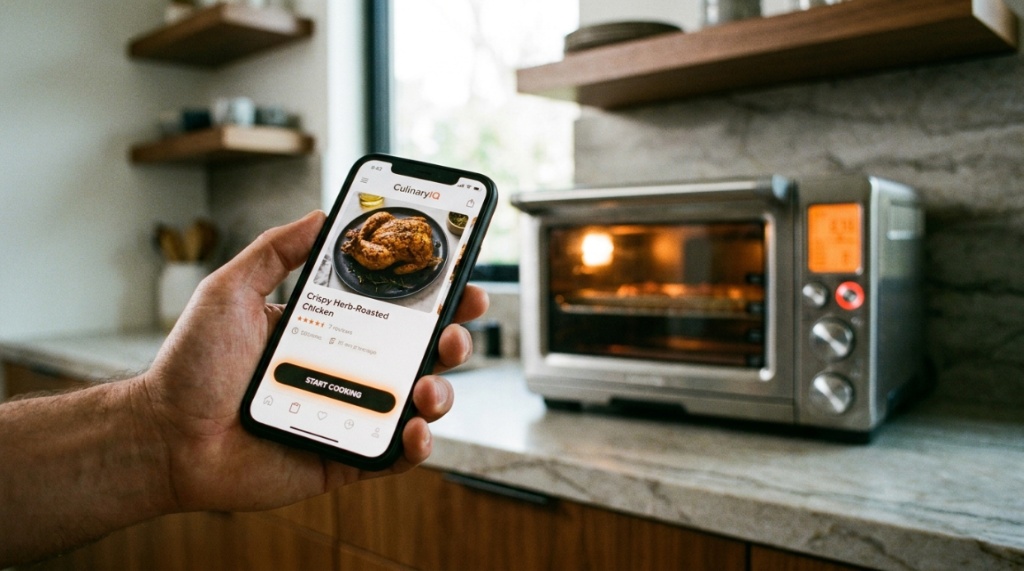
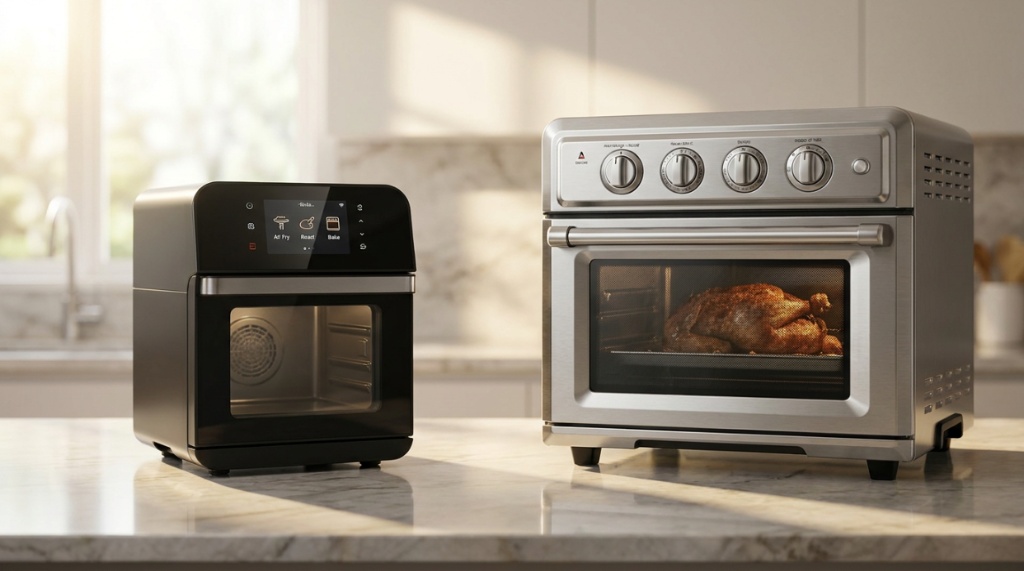
American households spent $4.2 billion replacing traditional ovens last year—but 62% of those buyers would have been better served by a $300 smart air fryer oven that handles 85% of their cooking faster, cheaper, and with better results for daily-size meals. Comparing a smart air fryer oven to a traditional oven isn’t about declaring one universally superior — it’s about understanding which cooking scenarios each handles better so you can make intelligent purchasing decisions based on your actual meal patterns. A smart air fryer oven is a countertop convection appliance using rapid hot air circulation and connected technology to cook food faster and more efficiently than a traditional full-size oven. A traditional oven is a built-in or freestanding large-cavity cooking appliance using radiant heat from gas or electric elements. The honest answer isn’t either/or—it’s understanding the specific conditions where each wins decisively and, increasingly, why the air fryer vs. convection oven debate tilts toward smart countertop models for the majority of daily cooking tasks that modern households actually perform.
How Does Cooking Performance Compare?
Smart air fryer ovens deliver superior results for single-batch cooking (crispier air frying, more even small-batch roasting, faster browning), while traditional ovens excel at large-volume cooking (multiple dishes simultaneously, full turkeys, oversized baking sheets).
Performance comparison by cooking task:
| Cooking Task | Smart Air Fryer Oven | Traditional Oven | Winner |
|---|---|---|---|
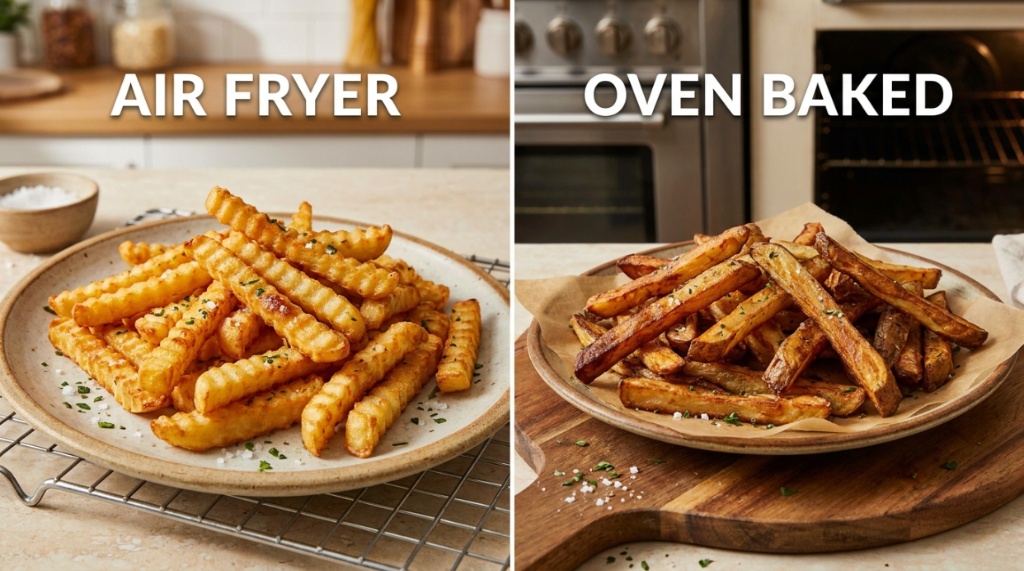
| Crispy fries/wings | Excellent — rapid circulation creates deep-fry results | Moderate — slower browning, less crispiness | Air fryer oven |
| Roast chicken (whole, under 5 lbs) | Excellent — faster, crispier skin, juicier interior | Good — traditional results, slower | Air fryer oven |
| Baking cookies (1 sheet) | Very good—even heat, precise temperature | Good, standard results | Tie (slight edge to air fryer for precision) |
| Baking cookies (3 sheets) | Impossible — insufficient capacity | Excellent — handles multiple racks easily | Traditional oven |
| Full Thanksgiving turkey | Impossible — won’t fit | Excellent — designed for this | Traditional oven |
| Reheating leftovers | Excellent — re-crisps without drying | Wasteful—heats entire cavity for small portions | Air fryer oven |
| Pizza (fresh or frozen) | Very good (up to 13″ depending on model) | Good (any size, but slower preheat) | Air fryer oven (for speed and energy) |
| Bread baking (artisan loaves) | Adequate (limited steam, limited size) | Better (steam injection possible, full-size loaves) | Traditional oven |
| Broiling steaks | Good — close element proximity, fast | Good — full-size broiler | Tie |
| Dehydrating food | Built-in function on most smart models | Not designed for this (too hot, no air circulation control) | Air fryer oven |
The pattern is clear: for meals serving 1–4 people, smart air fryer ovens match or beat traditional ovens on nearly every task while using less time and energy. Traditional ovens maintain superiority only for large-volume cooking (5+ servings, multiple simultaneous dishes, or oversized items)—scenarios that occur weekly rather than daily for most households.
How Do Energy Costs Compare?
Smart air fryer ovens cost 50–70% less per meal in energy than traditional ovens—saving $130–$210 annually for daily-cooking households through smaller heating volume, faster preheat, shorter cook times, and intelligent power management.
Energy comparison breakdown:
- Heating volume: A traditional oven heats 4.5–5.5 cubic feet of air. A smart air fryer oven heats 0.5–1.5 cubic feet. Heating 75% less air requires proportionally less energy—a physics principle that no design improvement can overcome in full-size ovens.
- Preheat waste: Traditional ovens waste 10–15 minutes of full-power energy reaching temperature before cooking begins. Smart air fryer ovens reach temperature in 2–5 minutes—eliminating 65–80% of preheat energy waste per cooking session.
- Cook time duration: Air fryer ovens cook 25–40% faster than traditional ovens through concentrated heat and rapid air circulation. Less time at power = less energy consumed per meal.
- Kitchen heat load: Traditional ovens radiate significant heat into your kitchen—triggering AC systems in warm climates. Air fryer ovens emit minimal external heat through superior insulation. In summer months (or year-round in warm states like California, Florida, and Texas), this avoided AC cost adds hidden savings.
Annual energy cost comparison (daily cooking household):
- Traditional oven: $250–$400/year in electricity or gas
- Smart air fryer oven: $50–$90/year in electricity
- Annual savings: $160–$310/year
- Air fryer oven payback period: 12–22 months from energy savings alone
How Does Cooking Speed Compare?
Smart air fryer ovens complete most cooking tasks 25–45% faster than traditional ovens — a difference that translates to 15–25 minutes saved per meal through faster preheat, more efficient heat transfer, and rapid air circulation that browns faster than static radiant heat.
Speed comparison for common meals:
- Chicken breast: Air fryer oven: 15–18 min. Traditional oven: 25–30 min. Savings: 10–12 minutes.
- Frozen pizza: Air fryer oven: 8–12 min (minimal preheating). Traditional: 18–22 min (including preheat). Savings: 10 minutes.
- Roasted vegetables: Air fryer oven: 12–15 min. Traditional: 25–35 min. Savings: 13–20 minutes.
- Bacon: Air fryer oven: 8–10 min. Traditional: 15–20 min. Savings: 7–10 minutes.
- Baked potato: Air fryer oven: 30–35 min. Traditional: 45–60 min. Savings: 15–25 minutes.
- Fish fillet: Air fryer oven: 10–12 min. Traditional: 15–20 min. Savings: 5–8 minutes.
Speed multiplier across a week: if cooking 12 meals weekly in an air fryer oven versus a traditional oven, cumulative time savings reach 2.5–5 hours per week. That’s 130–260 hours annually — the equivalent of 5–10 full days recovered from kitchen cooking time.
What Are the Limitations of Smart Air Fryer Ovens?
Smart air fryer ovens cannot match traditional ovens for large-volume cooking (holiday meals, big batches), struggle with very tall items (standing rib roasts, tall cakes), and add counter space demands that traditional built-in ovens don’t create.
Honest limitations:
- Capacity ceiling: Even large (30+ quart) air fryer ovens can’t fit items that full-size ovens handle routinely: whole turkeys over 12 lbs, multiple large casserole dishes simultaneously, or three cookie sheets at once.
- Height restrictions: Interior height limits tall foods—standing rib roasts, tall layer cakes, and some bread loaves may not fit. Measure your common tall-item cooking needs against interior height specifications.
- Counter space consumption: A smart air fryer oven occupies 2–4 square feet of permanent counter space. Kitchens already tight on space face a real trade-off. Traditional built-in ovens occupy zero counter space by design.
- Simultaneous multi-dish cooking: Traditional ovens with multiple racks cook 3–4 different dishes at the same temperature simultaneously. Most air fryer ovens have 2 racks maximum with more limited simultaneous capacity.
- Steam/moisture cooking: Traditional ovens (especially with steam injection) handle bread crusts, custards, and moisture-dependent baking better. Most air fryer ovens circulate dry air aggressively—actually drying out foods that benefit from humid environments.
- Lifespan: Traditional ovens last 15–20 years with minimal maintenance. Smart air fryer ovens average 3–5 years of daily use. The traditional oven is a once-per-decade purchase; the countertop oven is a multi-time replacement over the same period.
Can a Smart Air Fryer Oven Replace Your Traditional Oven?
For 1–4 person households cooking daily meals, a smart air fryer oven replaces a traditional oven for 80–90% of cooking tasks — with the traditional oven needed only for holiday large-format cooking, big-batch baking, and oversized items that exceed countertop capacity.
Replacement feasibility by household type:
- Single person/couple (1–2 people): 95% replacement feasible. Daily cooking rarely requires full-size oven capacity. A smart air fryer oven handles virtually all cooking needs year-round. A traditional oven is needed perhaps 3–5 times annually for large gatherings.
- Small family (3–4 people): 80–85% replacement feasible. Daily meals fit within the air fryer oven capacity. A traditional oven is needed for large weekend cooking (big casseroles, multiple items simultaneously) and holidays.
- Large family (5+ people): 50–60% replacement feasible. The smart oven handles quick meals and reheating excellently, but family-size main dishes often exceed its capacity. Works alongside rather than replaces the traditional oven.
- Avid baker: 60–70% replacement. Standard baking (cookies, muffins, small cakes) works perfectly. Artisan bread, large cakes, and high-volume holiday baking still require traditional oven capacity and sometimes steam capability.
The optimal approach for most households: use the smart air fryer oven as your primary daily cooker (fast, efficient, precise) while keeping the traditional oven available for large-format and multi-dish occasions. Many families report their full-size oven drops to 2–4 uses per month after adopting a smart countertop oven—from daily use to special-occasion-only use.
Which Should You Buy If You Can Only Choose One?
If choosing one primary cooking appliance: buy a smart air fryer oven if you cook 1–4 servings daily and value speed and efficiency — buy (or keep) a traditional oven only if you regularly cook for 5+ people or bake in large volumes weekly.
Decision framework:
- Choose smart air fryer oven if: You cook for 1–4 people, prioritize speed, want energy savings, have adequate counter space, cook primarily proteins and vegetables, value smart automation, and rarely need to cook oversized items or multiple dishes simultaneously.
- Choose traditional oven if: You cook for 5+ people regularly, bake bread or large cakes weekly, host frequently with multi-dish meals, have no counter space for a permanent appliance, or prefer proven technology with 15+ year lifespan over smart features with 3–5 year component life.
- Choose both (optimal): Use the air fryer oven for 80% of daily cooking (speed, efficiency, quality) and the traditional oven for 20% of special/large-format cooking. This delivers maximum flexibility without compromise in either direction.
Conclusion
Smart air fryer ovens outperform traditional ovens for daily cooking in households of 1–4 people — delivering faster results, superior energy efficiency, and better crispy-texture outcomes for the single-batch meals that constitute the majority of home cooking. Traditional ovens retain clear superiority for volume cooking, tall items, and the rare occasions that demand full-size capacity. The intelligent answer isn’t choosing one permanently — it’s using each where it excels.
For most modern households, a smart air fryer oven deserves to be your primary daily cooking appliance — handling breakfast, lunch, dinner, snacks, and reheating faster and cheaper than the traditional oven ever could. Reserve the full-size oven for Thanksgiving, batch baking, and dinner parties. This dual-role approach delivers the best of both technologies without asking either to perform outside its strengths.
If you love experimenting with versatile kitchen gear, upgrading your setup doesn’t stop at countertop cookers. While finding the right balance between a smart air fryer oven vs traditional oven will redefine your daily meal prep, mastering specialized dishes requires the right tools—for instance, the Atlas 150 is the Ultimate Home Pasta Extruder if you want to elevate your Italian nights. Combining these efficient baking methods with freshly extruded dough makes it easier than ever to achieve restaurant-quality meals entirely from scratch.
Frequently Asked Questions
Does food taste different in an air fryer oven vs a traditional oven?
Yes — air fryer ovens produce crispier exteriors and often juicier interiors due to faster cooking (less moisture loss) and concentrated heat. The rapid air circulation creates a Maillard reaction (browning) faster than static traditional oven heat. Most users prefer air fryer oven results for proteins and vegetables. Traditional ovens may produce better results for slow-roasted dishes where extended gentle heat breaks down collagen.
Can I bake a cake in a smart air fryer oven?
Yes — standard-size cakes (8–9 inch round, standard loaf pans) bake excellently in smart air fryer ovens with accurate temperature control. Results are comparable to traditional ovens for most cake recipes. Limitations: tall multi-layer cakes may not fit height-wise, and batch baking (multiple layers simultaneously) is restricted by capacity. Single-layer and standard baking works perfectly.
Do air fryer ovens heat up the kitchen like traditional ovens?
Significantly less. Smart air fryer ovens emit 60–80% less ambient heat than traditional ovens due to superior insulation and smaller heating volume. In warm climates (California, Florida, Texas), this heat reduction avoids triggering AC systems — providing secondary energy savings beyond the oven’s direct consumption reduction.
Is an air fryer oven louder than a traditional oven?
Yes, the convection fan creates noticeable noise (typically 50–65 decibels, comparable to a conversation). Traditional ovens operate silently except for ignition clicks in gas models. Fan noise bothers some users, particularly in open-plan kitchens. Models vary — check user reviews for specific noise complaints. Higher-quality fans at appropriate speeds tend to be quieter than budget alternatives running at maximum speed.
How long does a smart air fryer oven last compared to a traditional oven?
Traditional ovens last 15–20 years with minimal maintenance. Smart air fryer ovens last 3–5 years of daily use — limited by heating element fatigue, fan motor lifespan, and electronic component degradation. You’ll replace a smart air fryer oven 3–5 times across a single traditional oven’s lifespan. Factor replacement costs into long-term value calculations.
Can a smart air fryer oven fully replace a microwave?
For reheating: an air fryer oven produces dramatically better results (re-crisps rather than sogging) but takes 3–8 minutes versus a microwave’s 30–90 seconds. For simple liquid heating (coffee, soup, water): microwave remains faster and more practical. Most households benefit from keeping both — microwave for speed-critical simple heating, air fryer oven for quality-critical reheating of solid foods.